Calogero Bonasia
Organisational processes, knowledge and digital systems
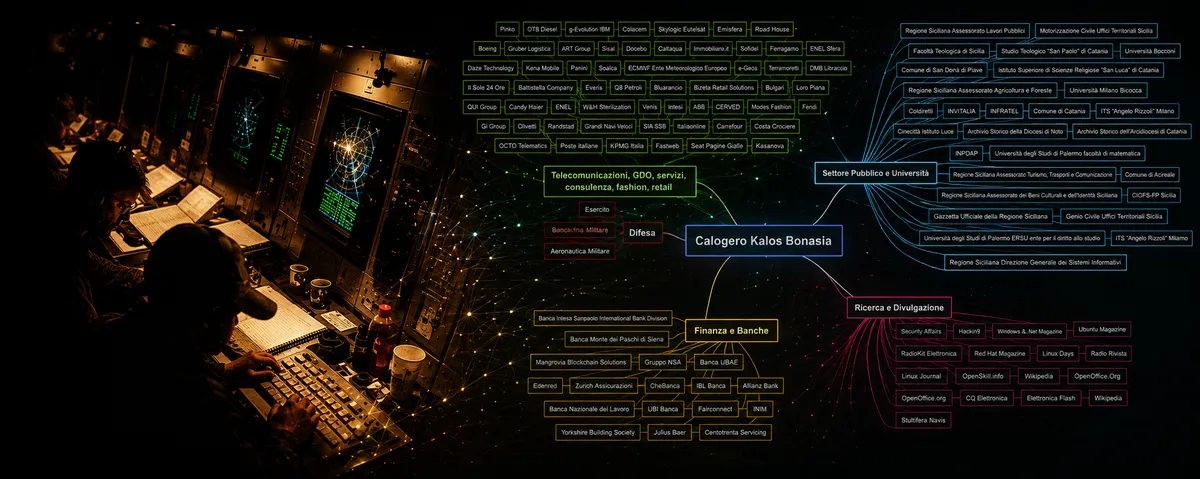
I have worked in information technology since 1991. Over the course of my career, I have worked with 113 organisations in defence, public administration, industry, telecommunications, financial services and business consulting.
Since 2022, I have worked as Executive Program Manager in the software division of a major industrial group. I support senior management in analysing priorities, available capacity, project progress, risks and dependencies.
My work starts from the way work is actually carried out. I follow the path of a request, a document or a decision: who is involved, which information they use, which rules apply, where the outcome is recorded and how exceptions are handled. I reconstruct processes, responsibilities, dependencies, controls and informal steps. On this basis, I design planning tools, digital workflows, control systems, reports and training activities.
The aim is to make work more intelligible: to understand what is happening, who is responsible, which information supports a decision and what consequences that decision produces.
Analysing and designing processes
I observe how people carry out activities, which information they receive, which decisions they make and what consequences those decisions produce. I compare actual work with the rules that govern it. I identify delays, duplications, unclear steps, overlapping responsibilities and recurring exceptions. I represent the process and propose changes that connect objectives, activities, responsibilities, information and controls.
Planning and controlling projects and programmes
I work with project managers, PMOs and management teams on planning and controlling work. My focus includes priorities, available capacity, progress, risks, dependencies and deviations from plan. I build representations that make it possible to observe several projects at once, identify the relationships between them and decide where action is needed.
Designing digital systems and workflows
I design and implement systems that connect activities, responsibilities, documents, data and controls. I have worked mainly with Jira, BigPicture, Confluence, Tempo Timesheets and eazyBI, configuring workflows, statuses, rules, automations, dashboards and reports.
Before configuring a tool, I need to understand how the work is carried out. Technology comes afterwards: it must support the process, make the necessary information available and help people make decisions.

Organising documents and knowledge
I work on processes for classifying, preserving, retrieving and using documents and information. I have worked extensively on document management in public administration and in other organisational settings, connecting regulatory requirements, responsibilities, archival classification, digital signatures, digital preservation and training.
An important part of this work consists in making events traceable: which document was used, who made a decision, which information supported it and what outcome followed.
Connecting development, operations and services
I have worked on software development and release cycles, connecting development and operations through automation, continuous integration, monitoring, documentation and release management. In IT Service Management, I have worked on service organisation, request and incident management, and the information required to carry out and control the work.
Building reports and control tools
I integrate data on priorities, capacity, progress, risks and dependencies. A report must make a situation understandable, show deviations and provide the information needed to decide. Control is useful when it makes it possible to act while the work can still be changed.
Training people and supporting adoption
I have delivered more than 7,500 hours of training to technical teams, project managers, PMOs, professionals and senior stakeholders. In my work, training often accompanies the introduction of new processes and tools. I explain why rules exist, how a process works, what each person’s role is, and how information should be produced and used.
The aim is to leave the group with a capability it can continue to use independently in everyday work.
Among the training activities I have delivered:
- Information Technology, CIOFS-FP Sicilia, September 1998 to July 1999;
- IT Service Management, ENEL Sfera, September 2003 to May 2004;
- Scrum: a process for agile improvement, University of Palermo, 25 October 2017;
- Long-term agile planning and the iron triangle, PMI Southern Italy Chapter, 8 July 2021;
- IT Audit and Regulatory Compliance, Cryptography and Cybersecurity, ITS “Angelo Rizzoli”, Milan, September 2021 to February 2022.
Professional experience
Military telecommunications
As an Italian Air Force officer specialising in telecommunications, I worked with rigorous procedures, defined responsibilities and systems in which continuity of communications had direct operational consequences. That experience shaped the way I observe processes: a procedure must be understandable, executable, verifiable and open to correction when conditions change.

Digital transformation and document management
Since 1995, I have worked on the digital transformation of documents and processes in public administration. My work has included assignments for the Sicilian Regional Government, the Italian Army and the Palermo Regional Agency for University Student Welfare.
For the Sicilian Regional Government, I designed and implemented electronic protocol and document-management infrastructures based on Linux and PAFlow. For the Italian Army, I also worked on automating the historical archives of military districts. For the Palermo Regional Agency for University Student Welfare, I worked on digital transformation and document management.
The work included process analysis and re-engineering, archival classification, digital signatures, digital preservation, Organisational Areas, and protocol-management manuals. Alongside the technical work, I trained system administrators and IT staff, and provided legal and organisational training for those responsible for electronic protocol and document management.
The work carried out with PAFlow formed part of initiatives launched by the Italian Authority for Information Technology in Public Administration to test interoperability standards for electronic protocol. PAFlow was an open-source project developed by Icube in Pisa and sponsored by AIPA. It was used as a reference implementation by public administrations and software companies.
I took part directly in developing PAFlow and applying it in several public-administration contexts. My contribution included designing document workflows, configuring solutions, and delivering technical and organisational training.
For the Italian Navy, as Senior Business Process Manager, I defined document processes and modelled workflows across the document life cycle. I worked on requirements, classification, preservation, responsibilities, solution configuration and staff training.

Processes and systems for projects and organisations
From 2013 to 2022, I designed and implemented digital solutions for different organisations in the Atlassian ecosystem. I worked on workflows, automations, multi-programme planning, reporting, release management and DevOps practices.
I have used Jira since 2004 and BigPicture since 2014. I have used these tools to represent work, connect projects and dependencies, support planning and build control systems for PMOs and management teams.
Current work
Since 2022, I have worked in the software division of an industrial group as Executive Program Manager. My work focuses on the relationship between priorities, available capacity, projects, dependencies and the information required by management. I build and maintain tools that make it possible to observe the system as a whole and bring data from different activities into a shared representation.
The method remains the one developed over the years: start from actual work, reconstruct its structure, and only then select appropriate processes, tools and representations.
Last updated: 04 September 2026.
etiam capillus unus habet umbram suam